Saturday, 16 November 2013

Katanga 400 club

I headed out about 4pm as usual on a Saturday afternoon, first off a little unsure where to herad but then realising I hadn't been down to the dambo from the bottom of the garden for a couple of weeks it was a bit of a no-brainer. A quick wander round the garden didn't yield anything too exciting until I heard an unfamiliar call from the tops of bamboos. I picked up African Paradise-Flycatcher and Yellow-breasted Apalis but it didn't seem to be coming from either of these and then a chunky fledgeling jumped into view next to the pair of Apalis. At first I was confused thinking it might be an early juvenile cuckoo species but that didn't seem right, overall it reminded me of a female campephaga cuckooshrike but then an adult Orange-breasted Bush-Shrike appeared and all became clear. I watched the adult feeding the youngster for a while and got some decent photos of the former if not the latter.

juvenile Orange-breasted Bush-Shrike, Frontier Mine, DR Congo

adult Orange-breasted Bush-Shrike, Frontier Mine, DR Congo
The dambo was down to the last few dregs of water as rain has still be very much at a premium and the last couple of weeks have been hot and sunny most days. Surprisingly there were a lot more large waterbirds around again including 35 Yellow-billed Stork and a record count of 20 Great White Pelican. A tall brown and white bird had me puzzled at first until it turned round and I realised it was juvenile Saddle-billed Stork, scanning around yielded not one but three young Saddle-bills so I surmise the adults that have been around since June must have bred very close by. They were both also present as well as the sub-adult making a great count of six in total.

juvenile Saddle-billed Stork, Frontier Mine, DR Congo

juvenile Saddle-billed Stork, Frontier Mine, DR Congo
I thought I could hear the buzzing call of a Sand Martin and careful scanning through the Barn Swallows revealed a single individual. Not a rare bird but a first for the site and more importantly my 400th species in Katanga Province in the 3.5 years I've been working here. I doubt there are too many other members of the Katanga 400 club!

Curlew Sandpiper, Frontier Mine, DR Congo

Lesser Grey-Shrike, Frontier Mine, DR Congo

Thursday, 14 November 2013

Lesser Kestrel

On the way back from the pit late afternoon I took a little trodden route (well at least for me) to duck round the blast guards. The site of a small falcon perched up on a small tree had me pulling a vaguely illegal u-turn. Getting out of the car I was painfully aware I had no optics with me but it looked so damn interesting. It was immediately obvious it was a male Kestrel but which one? Climbing up the berm on the side of the road it looked like the back and wings were unspotted and very bright and the overall impression was of a very slight and small bird. Good enough to secure it as a Lesser Kestrel, another new bird for the site. I left it more or less at that and drove back to the office for my bins and camera. The bird had looked pretty settled so it was surprising and disappointing to find it gone ten minutes later when I returned. As I was on work time I couldn't make an extended search, fingers crossed it will be around tomorrow again but it's probably a migrant which has dropped in briefly and already moved on.

Wednesday, 13 November 2013

A few new moths

Moth numbers and diversity are slowly increasing although this morning wasn't the best haul. The last couple of evenings I've finally had time to sit down with my photos and references and start to put some names to some of the recent additions. Not the best photos but some spectacular beasts.

Triple Striped Peacock (Chiasmia subcurvaria), Frontier Mine, DR Congo

Silver Pendant (Problepsis digammata), Frontier Mine, DR Congo

Oblique Barred Semiothisa (Chiasmia rectistriaria), Frontier Mine, DR Congo

Neomardara africana, Frontier Mine, DR Congo

Viettessa margaritalis, Frontier Mine, DR Congo

Lacipa quadripunctata, Frontier Mine, DR Congo

Cyligramma fluctuosa, Frontier Mine, DR Congo

Variable Prince (Holocerina smilax), Frontier Mine, DR Congo

Sunday, 10 November 2013

Whitethroat

A quick check of the floodlights early morning yielded a few interesting looking moths but none that I have identified as yet. Then it was off to the tailings dam for the usual Sunday morning rounds. Water levels were a little down concentrating the waders but again no sign of a yank or anything else out of the ordinary. An unstreaked acrocephalus was flying around but the views were too poor to attempt an identification. As I was leaving I glimpsed another interesting looking passerine and up popped a Whitethroat, a new species for the site and a decent record for the area as it's not common on passage.
Black-winged Stilt, Frontier Mine, DR Congo

Hottentot Teal, Frontier Mine, DR Congo

Greater Whitethroat, Frontier Mine, DR Congo
The rest of the morning was a bit of a slog around the camp in pretty hot conditions. Odds and ends and a few nice photos but nothing much to write home about. Found another African Paradise-Flycatcher nest under construction and the Chestnut-mantled Sparrow-Weavers seemed to be on their second nest. Nice views of a brute of a Grey-headed Bush-Shrike as well as a pair of Purple-throated Cuckooshrike. A Brubru came in to tape, not a species I see often. The dambo was pretty dry again but a Saddle-billed Stork was in residence again, three Great White Pelican drifted over and a Brown Snake-Eagle flew through.

Cabanis's Greenbul, Frontier Mine, DR Congo

Broad-billed Roller, Sakania Mine, DR Congo

Blue Waxbill, Frontier Mine, DR Congo

Spotted Flycatcher (ducking after an accipiter flew through), Frontier Mine, DR Congo

Chestnut-mantled Sparrow-Weaver, Frontier Mine, DR Congo

Grey-headed Bush-Shrike, Frontier Mine, DR Congo

Brubru, Frontier Mine, DR Congo

male Purple-throated Cuckooshrike, Frontier Mine, DR Congo

female Purple-throated Cuckooshrike, Frontier Mine, DR Congo

Brown Snake-Eagle, Frontier Mine, DR Congo

Red-backed Shrike, Frontier Mine, DR Congo

Saturday, 9 November 2013

Peregrine Falcon

Considerably more moths roosting around lights early morning, some familiar ones including Usta terpshicore and Phiala hologramma as well as a couple of new ones although the only one I have thus far identified is Teracotona trifasciata.

Teracotana trifasciata, Frontier Mine, DR Congo

Phiala hologramma, Frontier Mine, DR Congo

Usta terpshicore, Frontier Mine, DR Congo

The Plant Manager alerted me mid-morning to a Sunbird nest just outside the office so I went and had a quick look. Sure enough a rather nervous looking female Amethyst Sunbird poked a head out of the hanging structure and then flew off. A slightly disturbed location for a nest but hopefully they'll be successful. Looking over the office roof I noticed a male Red-headed Weaver also busy nest-building high in a Fever Tree. One nest already completed, he was starting work on the next.

Amethyst Sunbird nest, Frontier Mine, DR Congo
Mid-afternoon I decided to take a slow drive around the camp. Overall it was fairly quiet but I started by getting close to a nice Brown-headed Kingfisher and then getting photos for the first time of the resident troop of Malbrouck (recently afforded full species from the Vervet Monkey complex). The first young Puku of the season was also around but it kept with the herd in long grass. High numbers of Namaqua Dove were noted, perhaps swollen by birds migrating back north. Migrants in general were a little less in evidence than of late but good numbers of Red-backed Shrike were present although they were typically difficult to photograph. Back at home a female/immature type Eurasian Golden Oriole was in a large tree at the bottom of the garden. The dambo was looking fairly dry and large waterbird numbers were further reduced. As I headed back up to the house with the light failing I was pretty surprised when a Peregrine flew low overhead and perched in a dead tree in the garden. Another new species for the site, number 315. I'm pretty sure I've seen them around the mine before but always without binoculars and thus not possible to confirm.

Brown-headed Kingfisher, Frontier Mine, DR Congo

Malbrouck, Frontier Mine, DR Congo

Red-backed Shrike, Frontier Mine, DR Congo

Red-backed Shrike, Frontier Mine, DR Congo

Peregrine Falcon, Frontier Mine, DR Congo

Friday, 8 November 2013

Wattled Starling


The Plant Manager called me early afternoon to say he’d found a Hamerkop nest by one of the small dams and was a bit concerned as they urgently needed to excavate sediments out of the dam which is badly silted-up. I went down and had a look and sure enough there was a monster mess of wood in a tree, passing for a Hamerkop nest. No sign of the adults but they’re often on the dams around the plant looking primarily for amphibian prey. Many years ago when I worked in the Central African Republic I discovered in that part of the world at least that the Hamerkop was revered and feared in equal measure. No-one could believe that such a small bird needed such a huge nest (they can extend to over one tonne of material) and they believed that Hamerkop’s were indeed Witch Doctors and transformed into human form at night to wreak havoc. Hmm…

I decided that as I was out of the office I’d head down to the tailings dam on the pretense of checking the cracks in the causeway but really wanting to have a quick scout for birds. Driving down I had a real WTF is that moment as a really odd looking pale passerine popped up on the fence next to the road. I spun a U-turn and cruised back to the spot and could see the bird still there, without binoculars it was pretty hard to see what I was looking at but it appeared to be at least partially albinistic or very pale leucistic. Shape, size and call indicated probably a Short-winged Cisticola, and it was with a normal plumaged individual of the same species. Will have to go back some time and try and get photos.

Driving out on the tailings causeway I noticed that existing cracks had widened and deepened and more were appearing and then I got to the end and “…WTF is that”?! Another pale looking, but much larger, passerine perched on a grass stem. I was puzzled but as I got closer it flushed and flew revealing a white rump and my brain clicked – Wattled Starling! OK, not rare, but another new species for the site and a good result. The list is up to 314 now. Without binoculars I could only look at birds close by but this included a sad looking Abdim’s Stork with a broken tarsus. The Black-winged Stilt was still brooding and a second female was now sitting just a few metres away. I watched both birds dipping breast feathers into nearby water and coming back to cool the eggs, to be fair it was mid-thirties in the shade, and they didn’t have any! Pretty neat behavior to observe though.
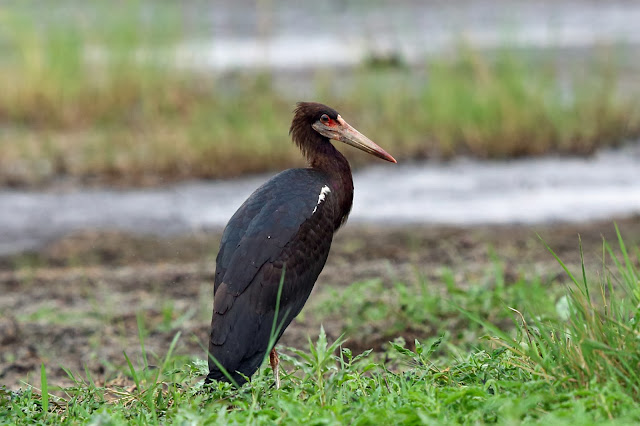
Abdim's Stork, Frontier Mine, DR Congo

I dropped by the house briefly early evening before heading up to the club and the Barn Owl was perched in a tree in the garden again. Up at the club one of the small Impala herds passed through grazing on the lawn and amongst them were the first young of the year, perhaps three or four but difficult to see in the shadows. They looked pretty small, one to two weeks old maximum.

Wednesday, 6 November 2013

Dark-Chanting Goshawk


Driving around site this morning I was surprised to see a Dark-Chanting Goshawk perched on an electric pole. Hardly a species to win any rarity awards but pretty unusual on the site and he first record this year. My guess is they prefer more open habitats. Also interesting to see was a pair of Broad-billed Roller prospecting a hole in in the top of a dead trunk. This would be a new confirmed breeding species for the site should they choose to build. I sat down and tried to work out the number of confirmed breeding species on site the other evening and it’s a paltry 46! There are a lot that I am sure must breed but I haven’t paid enough attention to prove it.

Leaving the office at dusk a large flock of Cattle Egret flew over, presumably in their way to roost on the tailings dam. Estimated around 100 birds this was the largest flock I've seen at the site.

For the last two weeks or so I've been hearing a Barn Owl calling in the garden around 1900 and this evening on the way to the camp bar it was perched on a bough over the drive visible in the headlights.

Dark-Chanting Goshawk, Frontier Mine, DRC